Thermocouple Interfacing With Arduino UNO
Thermocouple is a device consisting of two dissimilar metals connected together creating a junction which is used for measuring the temperature
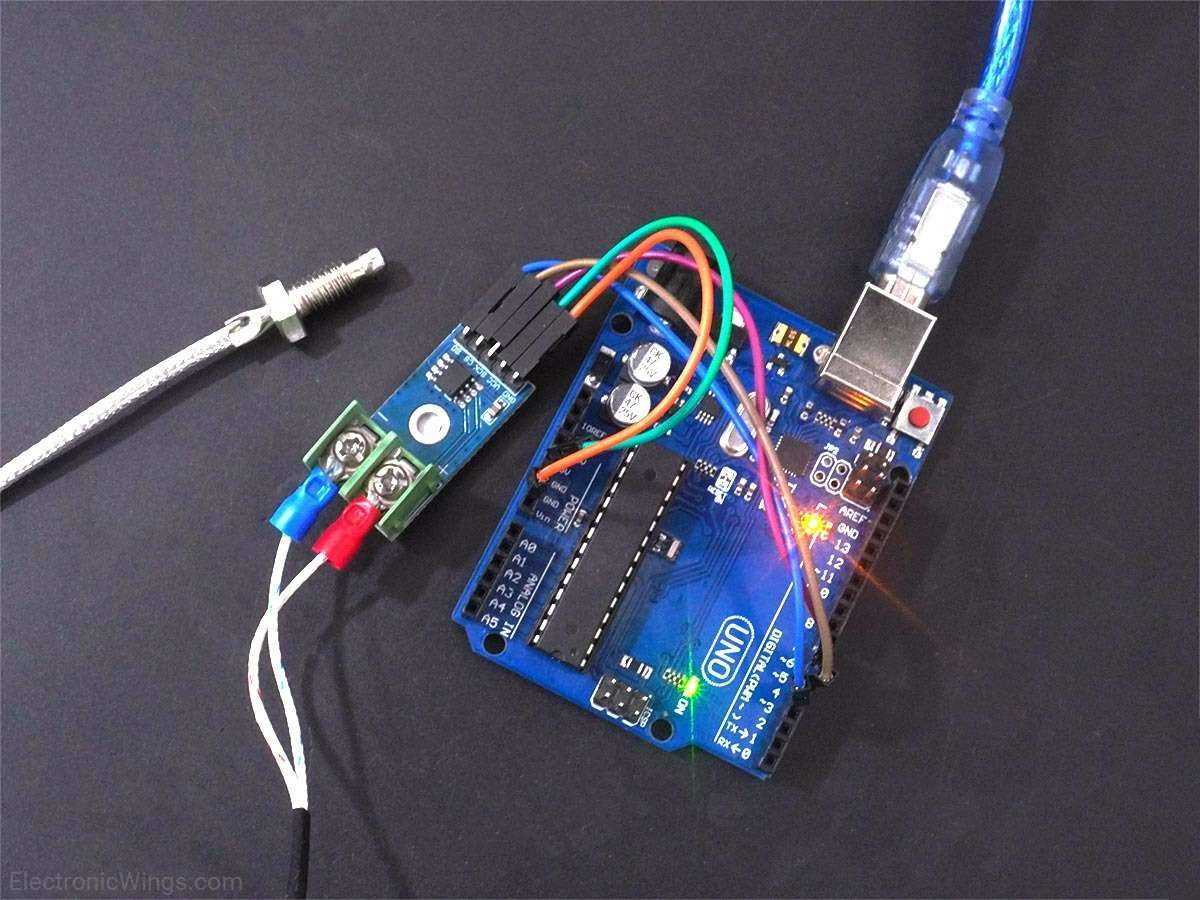
Overview of Thermocouple
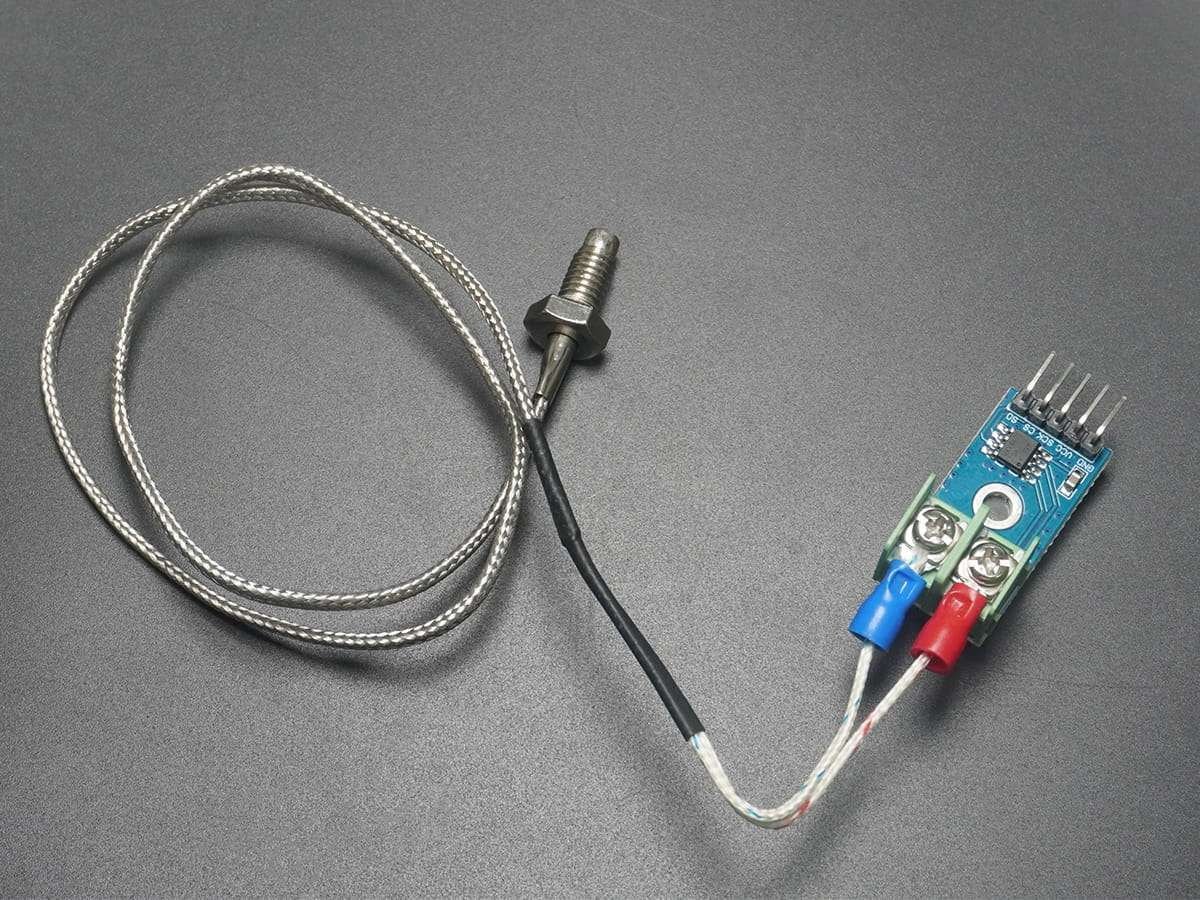
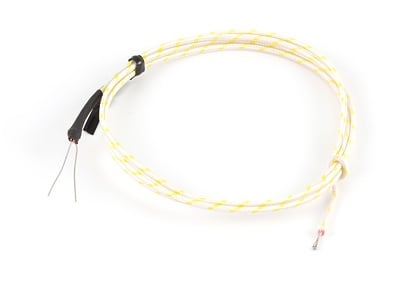
Thermocouple consists of two different conductors forming an electrical junction at different temperatures.
Due to thermo effect, thermocouples produce a voltage which is dependent on temperature.
Temperature can be found out from this voltage.
ADC output of this voltage can be processed by a microcontroller to give the temperature.
For more information about Thermocouple and how to use it, refer the topic Thermocouple in the sensors and modules section.
Connection Diagram of Thermocouple with Arduino
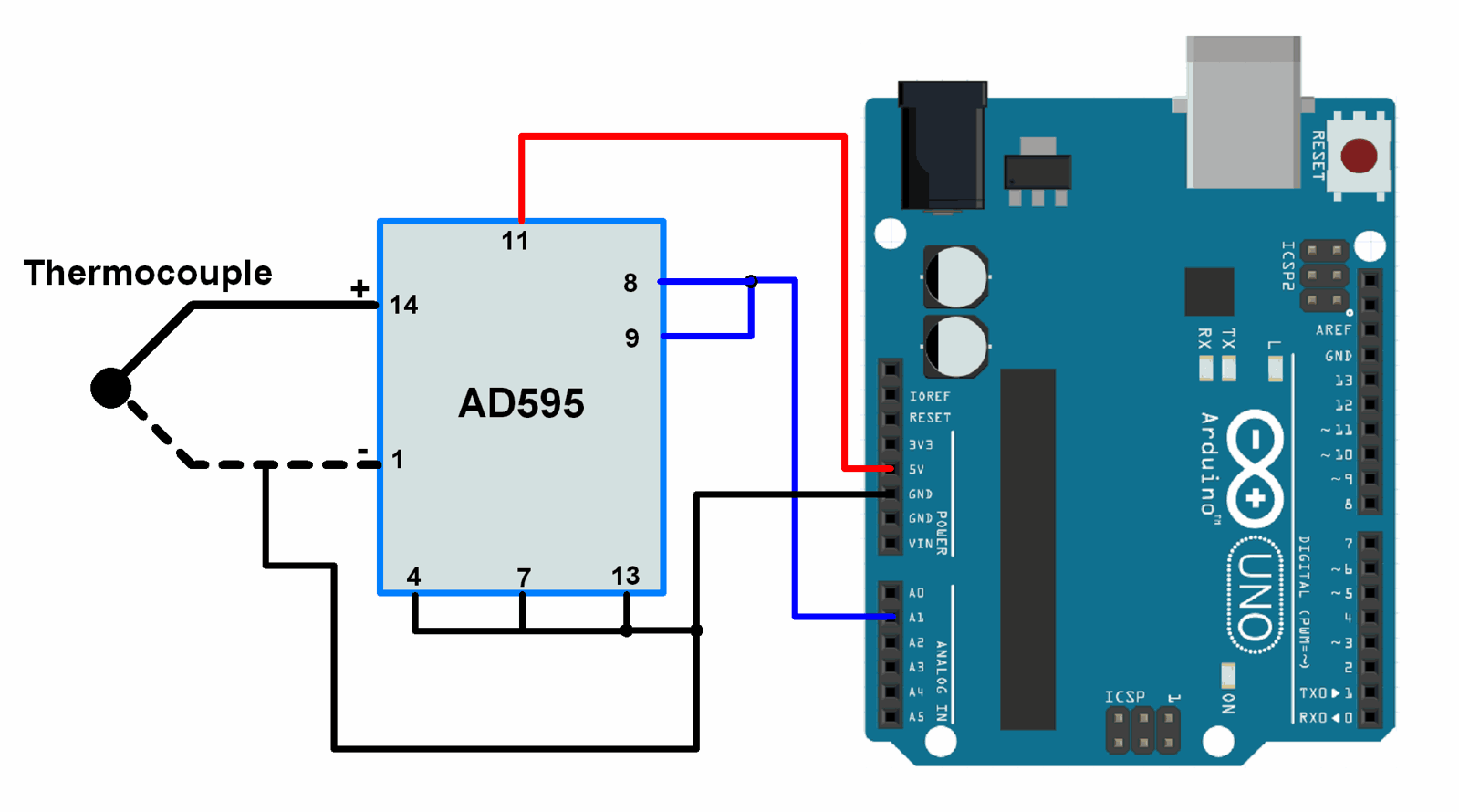
Measure Temperature using Thermouple and Arduino Uno
Measuring temperature using a thermocouple and displaying it on Arduino serial monitor.
Here, AD595 is used to connect thermocouple to UNO board. The output voltage from AD595 is given to ADC of UNO board.
The ADC value is then converted into ºC using the formula given below.
Why 0.0027 subtracted in above formula
AD595 provides output as follows,
AD595 Output = (Type K Voltage + 11 uV) x 247.3
- The above formula shows AD595 provides output with amplified offset voltage. So, we have to eliminate total offset voltage (11 uV * 247.3) to get accurate temperature value.
Note : 11 uV is an offset voltage of IC AD595 instrumentation amplifier for K-type thermocouple.
AD595
- AD595 is a complete instrumentation amplifier (Monolithic Thermocouple Amplifiers) with a Cold Junction Compensation.
- AD595 is compatible for K-type thermocouple, while AD594 is compatible for J-type thermocouple.
- It combines ice point reference with the pre-calibrated amplifier to produce a high level output (10mV/ºC) directly from the thermocouple output.
- AD595 gain trimmed to match transfer characteristic of K-type thermocouple at 25ºC. The output of K-type thermocouple in this temperature range is 40.44uV/ºC.
- The resulting gain for AD595 is 247.3 (10mV/ºC divided by 40.44uV/ºC).
- The input offset voltage for AD595 is 11uV, this offset arises because the AD595 is trimmed for a 250 mV output while applying a 25°Cthermocouple input.
- Output of AD595 is,
AD595 Output = (Type K Voltage + 11 uV) x 247.3
- The IC AD595 pin diagram is shown in figure below.
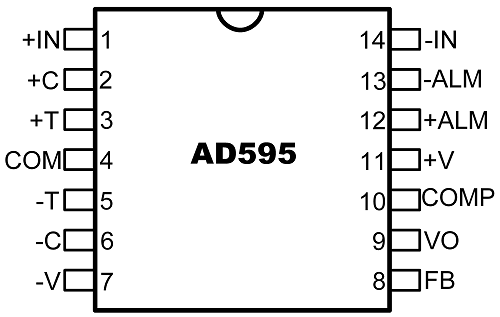
Note: If you connect +5 volt and ground to the AD595 you can measure the temperature from 0ºC to +300ºC. For more information, refer AD595 datasheet.
Thermocouple Code for Arduino Uno
const int thermocouple_input = A1;	/* AD595 O/P pin */

void setup() {
  Serial.begin(9600);	/* Define baud rate for serial communication */
}

void loop() {
  int adc_val;
  float temperature;
  adc_val = analogRead(thermocouple_input);
  temperature = ( ((adc_val * 4.88) - 0.0027 ) / 10.0 );
  Serial.print("Temperature = ");
  Serial.print(temperature);
  Serial.print("\n\n");
  delay(1000);
}
Video of Temperature Measurement using Thermocouple and Arduino
Components Used
Powered by
Downloads
Comments13
Join the discussion — share a question or tip.
- PA
Taken from AD595 data sheet: Using AD595 Objective of 10mV per C AD5959 Output Voltage (OPV) = C*10mV + 11uV*247.3 Therefore: C = (OPV - 11uV*247.3) / 10mV ---> Using 1/10mV = 1/10E-3 = 100 = (OPV - 0.0027 ) * 100 = OPV*100 - 0.27 Example OPV=2.603V ( which of course is 2603 mV) C = 2.603*100 - 0.27 = 260.03 degrees C Arduino 8bit ADC provides 1023 values. Each value represents 5v/1023 = 4.89mV Therefore to find AD 595 OPV from ADC, multiply ADCvalue by 4.89E-3
- MA
Thanks for sharing, but there is something wrong with your equation and code. The ADCvalue is the the result of analogRead(), which read the voltage of output from AD595 and convert it into digital number ranging from 0 to 1023. And then you multiply 4.88, which comes from 5V/1024 =0.00488V=4.88mV, you use 4.88mV here, it's fine. But the unit of offset "0.0027" is V, which comes from 11uV*247.3=0.0027V=2.7203mV. So you used mV as unit for the front, but V as unit for the back. That's not right. It confused me a lot and cost me some time to balance the equation, hope you find it and correct it soon. Kind regards
- NO
I'm also having trouble with the code, but I couldn't quite get what you are trying to say. Are you saying we should use "2.7" instead in the code?
- MA
Hi, Fantastic post! is it possible to connect 7 Segment display to have TC temp display ? & how segment will be connected? Thanks for your help.
- HE
is it possible to connect a type T thermocouple?
- AB
how to cabler an ad 595 and ad 594 type amplifier with an arduino uno card
- MA
Hello, I was wondering if you could tell me what thermocouple you used. thanks
- ED
Hi, Thank you for the great post, very informative. Could you please let me know if it is possible to connect multiple thermocouples and if yes, what would be the approach? I need to connect around 50 of them to Arduino. I really appreciate your help.
- KA
It depends on the number of analog pins that you have on your arduino; I'm also working on the same project where I have to connect 4 thermocouples. I already did.